
METHODS
For this purpose, we studied two parameters, that is, drug release both in ex vivo conditions and cytotoxicity
profile. For ex vivo skin permeability studies skin of male Sprague Dawley rats, goats, and human
cadaver was selected. For in vitro cytotoxicity study, SK-MEL-5 melanoma cell lines were used. %
cell death was concentration dependent.
RESULTS
The highest concentration (96 ?M) maximum cell death was found. The nanoemusion had highest inhibitory
effect in any concentration than control or ME. Similar results were obtained for permeation study.
NE had better permeation property than other.
CONCLUSION
Based on the permeation results, we found that highest amount of 5-fluorouracil collected in the viable
part of the human cadaver and goat skin model from NE as compared to other preparations. Finally, it
can be concluded that NE of the model drug had better properties in cytotoxicity and skin permeation
than marketed topical product.
Keywords: 5-Fluorouracil; microemusion; nanoemulsion; skin cancer
5-Fluorouracil (5-FU) is used as an anti-cancer
drug in the treatment of various diseases, both localized,
such as skin cancer and actinic keratosis.[
The existing formulas are available for the topical
application of 5-FU, in the form of a cream or solution,
and the concentration of 5-FU is set up to 0.50%, which
can be taken once a day, for topical use. The commercially
available drugs have the disadvantage of a very
short retention time and less permeation[
Management of tumorigenic effects on the skin, as
well as minimizing local and systemic side effects of
5-FU should penetrate the skin layers and exert effects
on the epidermis and dermis. The existing routes of administration
of 5-FU, have been placed on intravenous
and local routes of administration;[
To produce 5-FU microemulsions (MEs) and nanoemulsion (NE), surfactant-cosurfactant was mixed with oil. Distilled water was added drop wise with the help of a burette by gentle stirring at a constant temperature. The surfactant and co-surfactant were mixed into three particular ratios 1:1, 2:1, and 3:1.
Characterization
Ex vivo skin permeation studies
The skin of male Sprague Dawley (SD) rats, goats, and
human cadaver was selected for ex vivo skin permeability
studies. Male SD rats, 6-7 weeks of age and weighing
about 180-200 g. The Institutional Committee for Animal
Ethics (approval no. SRIP/IAEC/2019-20/191/12)
was approved for experimental protocol. The rats were obtained from research institute's animal house.
Goat-skin, weighing 8-10 g taken from a local slaughter
house in Bhilai, Chhattisgarh, India, as well as the
human skin, which obtained from the Shri Shankarcharyacharya
Institute of Medical Sciences (letter no.
SSIMS/320).
Permeation studies
The ex vivo skin penetration tests were performed to
determine and compare skin penetration parameters
between 5FU loaded ME, NE, and marketed cream.
The experiments were carried out in the static Franz
diffusion cell (9 mm clear glass jacket). The Franz diffusion
cell consisting of two compartments: The receptor
and donor compartment.
To preceding permeation study, isolated part of back skin of human cadaver, goat, and rat was mounted between the receptor and the donor compartments, while keeping the human cadaver, goat, and rat stratum corneum site of the skin facing toward the donor compartment.
At certain time intervals 1, 2, 4, 6, 8, and 12, after 24 h, 0.5 ml of the volume was taken from the intake opening and immediately replaced with an equal volume of fresh medium at the same temperature, to maintain the sum of the effects of phase at a constant level. The value of 5-FU in the collected samples was measured using the HPLC method.
5-FU permeability was determined in the different skin types human cadaver, rat and goat, for each of the 5-FU cream, 5-FU ME, and 5-FU NEs with 5-FU control, For calculating permeability coefficient (Kp), steady state for human cadaver, rat, and goat skin divided with initially concentration (C0) of 5-FU. A graph is plotted of the period of time between the copenetration of 5-FU (in µg/cm2) and time (hours) to have a specific part of the diffusion cell area.
Enhancement ratio and permeability coefficient
were determined by use of equation 1 and 2.[
Cytotoxicity studies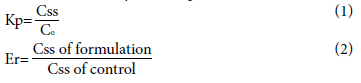
For in vitro cytotoxicity study SK-MEL-5 melanoma
cell lines were used, with the relative effects of selected
formulations and control. MTT measures cellular respiration,
and the amount of synthetic formazan in the
culture correlates to the number of live cells. A change
in cell number corresponds to a change in the amount of formazan generated, which measures the degree of
cytotoxicity induced by the medication. A drug's IC50
(concentration) has the capacity to kill 50% of cells and
can calculate the degree of its cytotoxic effect.
Table
In vitro Cell Lines Studies
The in vitro therapeutic efficacy of optimized 5-FU-ME
and 5-FU-NE on melanoma cancer cell lines has been
evaluated (SK-MEL-5 type). The melanoma cell lines
were tested in vitro for cytotoxicity (percent) using
various molar concentrations of 5-FU from 5-FU-C,
5-FU-ME, and 5-FU-NE. Cell survival (percent) was
also assessed using different molar concentrations of
5-FU (3, 6, 12, 24, 48, and 98 M) in 5-FU-C, 5-FUME,
and 5-FU-NE (Fig.
5-FU: 5-Fluorouracil; ME: Microemulsions; NE: Nanoemulsion; SC: Stratum corneum.
Acknowledgments: The authors would like to express thanks Neon Laboratories Ltd., Mumbai, India, for providing the drug as a gift sample. We also express our kind gratitude to Indian Institute of Integrative Medicine, Jammu, India and All India Medical Institute of Medical Sciences, New Delhi, India.
Peer-review: Externally peer-reviewed.
Conflict of Interest: All authors declared no conflict of interest.
Ethics Committee Approval: The study was approved by The Shri Rawatpura Sarkar Institute of Pharmacy Ethics Committee (No: SRIP/IAEC/2019-20/191/12, Date: 22/02/2020).
Financial Support: This study has received no financial support.
Authorship contributions: Concept - H.S.; Design - H.S.; Supervision - C.D.K.; Funding - C.D.K.; Materials - S.D.P.; Data collection and/or processing - G.K.S.; Data analysis and/or interpretation - H.S.; Literature search - G.K.S.; Writing - S.D.P.; Critical review - H.S.