

METHODS
The study was conducted retrospectively using computed tomography images of 20 breast cancer patients,
10 right and 10 left received radiotherapy. After preparing three-dimensional conformal radiotherapy
(3DCRT), intensity modulated radiotherapy (IMRT), and volumetric modulated arc therapy
(VMAT) plans, IMRT based hybrid plans, named as 3DCRT+IMRT, IMRT+VMAT, and created with
50-50% dose weighted combinations for each patient using 3DCRT and VMAT. Dose volume histogram
data were used to evaluate the plan quality. The comparison parameters are critical organ (OAR) doses,
homogeneity index (HI), conformity index (CI), and monitor unit (MU) number.
RESULTS
Among the hybrid plans created with IMRT, the CI and HI values for the right and left breast irradiation
were found to be the best in IMRT+VMAT hybrid plans and the doses to critical organs could be
reduced using the 3DCRT+IMRT hybrid plans. At the same time, the quality of the plan increased by
reducing the contralateral breast dose, irradiated breast volume, and heart dose. IMRT+3DCRT hybrid
application should be considered as an option to reduce critical organ doses.
CONCLUSION
In cases that critical organ doses need to be reduced, IMRT+3DCRT hybrid technique should be considered
as an alternative option.
Keywords: Breast cancer; hybrid plan; radiotherapy; treatment plan comparison
The aim of radiotherapy is to accurately deliver
high radiation dose to the target volume without exceeding
the tolerance doses of critical organs.[
In recent years, techniques such as IMRT and
VMAT have been widely used, and there has been a
perception that conformal techniques are no longer
needed. This study shows that critical organ doses
can be reduced by using advanced techniques such as
IMRT and conformal techniques together.
The dose applied to the tumor can be increased
while the doses received by the surrounding tissues
can be minimized with innovative planning techniques
such as volumetric modulated arc therapy (VMAT) and
intensity modulated radiotherapy (IMRT).[
Each radiotherapy technique has both advantages
and disadvantages. With 3DCRT, some of the volume of critical organs adjacent to the tumor is exposed to
high doses. In other treatments with IMRT and VMAT,
healthy tissues are exposed to a low dose bath. In order
to eliminate the disadvantages of the techniques,
hybrid treatment methods have been developed by using
a combination of different techniques. The hybrid
technique created by the combination of 3DCRT and
IMRT techniques was first used in the treatment of
breast cancer.
The purpose of current study is to investigate the
plan quality of IMRT, and hybrid techniques based on
IMRT in breast cancer patients by comparing the doses
to critical organs and the conformity and homogeneity
indexes.
Image Data Acquisition
The computed tomography (CT) images of the patients
were obtained using Philips Brillance Big Bore computed
tomography device. While obtaining CT images,
immobilization tools were used to accurately repeat
the treatment position and to ensure the stability of the
patient. The patients were placed on an inclined plane
with the head gantry and supine, and the arm was fixed
on the head on the side of the breast to be irradiated
with the vacuum bed. CT images were acquired using
the varian real-time position management system
(RPM). While acquiring the breath-controlled CT of
the patient, the amplitude (amplitude) and breath hold
(breath holding) options of the RPM system were selected.
With this technique, it is aimed to reduce the
doses received by the ipsilateral lung and heart. The CT
dataset were transferred to the Eclipse (Varian Medical
Systems) 15.6 treatment planning system (TPS).
Delineation of Target Volume and OARs
The clinical target volume (CTV), ipsilateral lung, contralateral
lung, heart, and contralateral breast tissues
were contoured by the radiation oncologist in accordance
with the recommendations of the ICRU protocols
50, 62, 83. No margin was given to the contoured
CTV, and treatment plans were prepared directly to the
breast tissue.
Treatment Planning and Dose Prescription
Five different treatment plans were prepared on CT
data of patients by same medical physicist in Eclipse
15.6 TPS. First, the plans were created using 3DCRT,
IMRT, and VMAT planning techniques for each patient.
Then, IMRT+3DCRT and IMRT+VMAT hybrid
plans were generated for each patient by combining
the 3DCRT, IMRT, and VMAT plans. Thus, each hybrid
plan was consisting of two components. The dose
prescription of each component of hybrid plan was
made to be 50% of the fraction dose. The isocenters of
CTVs in all plans were the same point. In the prepared
treatment plans, HD-MLC was used and calculations
were performed using the Analytical Anisotropic Algorithm
with a dose grid of 0.25 cm. The prescription
dose to CTV was 5000 cGy in 25 fractions for all plans.
All plans were created with 6 MV photon beams from
a Varian Trilogy linac equipped. The dose rate was selected
as 600 MU/min. The dose normalization was
made so that 95% of the CTV receiving 4500 cGy.
• Three-dimensional conformal radiotherapy
(3DCRT) plan
3DCRT plans were prepared using the two tangential
fields with beam angles ranging from 300°-100° for the
left breast and 50°-200° for the right breast. The table
angle was 0° and collimator angles were adjusted to be
15°-345° or 30°-330° according to the patient anatomy.
• Intensity modulated radiotherapy (IMRT) plan
IMRT plans were created with a total of seven angles
obtaining by choosing 2 non-reciprocal tangential
angles for all patients and adding 15 degrees to these
angles. The defined beam angles for the left-sided and
right-sided breast cancer patients were 300°, 315°, 330°
-100°, 85°, 70°, 55°, and 50°, 35°, 20°-200°, 215°, 230°,
245°, respectively. The selection of the beam angles
may vary depending on the patient anatomy.
Table angle is 0° and collimator angles are adjusted to be 15°-345° or 30°-330° according to the patient anatomy.
• Volumetric modulated arc therapy (VMAT) plan
Two partial arc was used in VMAT plans for all patients.
In the left-sided breast cancer treatment plans,,
the two arcs were set from 300° to 160° (clockwise) and
160° to 300° (counterclockwise), respectively. In rightsided
breast cancer treatment plans, the two arcs was
set from 200° to 50° (clockwise) and 50°-200° (counterclockwise),
respectively. Table angle is 0° and collimator
angles are adjusted to be 15°-345° or 30°-330°
according to patient anatomy.
• Hybrid plan
IMRT+3DCRT and IMRT+VMAT hybrid plans, which
are separate combinations of IMRT and VMAT plans,
were prepared with equal dose weights (50%-50%).
The prepared IMRT and their hybrids, 3DCRT+IMRT,
were normalized so that 95% of the target volume received
4500 cGy in the IMRT+VMAT plans.
The critical organ dose limits are given in Table
The 4500 cGy dose distributions and beam angles
for IMRT, IMRT+3DCRT, and IMRT+VMAT are
shown in Figures
Figure
Comparison of Treatment Plans
In the equation [
D2%=Dose received by 2% of target volume (minimum
dose received by target)
D98%=Dose received by 98% of target volume
(maximum dose received by target)
D50%=Defined as the dose received by 50% of the
target volume.
The HI value approaching "0" indicates that a more
homogeneous treatment plan is obtained.
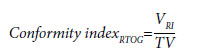
In this study, the formulation defined by RTOG was
used for the CI value. CI formula;[
VRI=Reference isodose volume
TV=Defined as the target volume.
According to this formulation, the ideal value for
a conformal plan is "1". A CI value between "1" and
"2" indicates that the treatment is suitable for RT. As
the conformity index value gets to "1" closer, the quality
of the plan increases, and as it gets farther away, it
decreases.
The comparison of the data obtained in the prepared
treatment plans was made with the Wilcoxon
Signed Ranks test belonging to the SPSS statistical
program. As a result of the comparisons, the statistical p<0.05 condition obtained from the SPSS program
was accepted as a significant difference. The obtained
mean, standard deviation, and p values were used in
the plan quality assessment.
The comparisons of treatment plans were performed
based on dose volume histogram (DVH) data. The
comparisons were made considering the PTV, OAR
doses of each patient, and CI, HI, MU data. The statistical
analyses were conducted using the IBM SPSS (version
26.0) software package homogeneity index (HI)
and conformity index (CI) values were calculated in
five plans for comparisons to be made in terms of plan
quality. The HI values were calculated by considering
the equation recommended in the ICRU 83 report.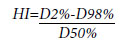
The ipsilateral lung V20, V10, V5, mean dose, contralateral
lung V10, V5, mean dose, heart V30, V5,
mean dose, contralateral breast V5, mean dose, max
dose, and 5 Gy dose volume values are shown in Table
The MU values of IMRT, IMRT+3D, and
IMRT+VMAT hybrid plans for the right and left breast
irradiations are shown in Table
There were no statistically significant differences among IMRT, IMRT+3DCRT, and IMRT+VMAT plans in CI and HI for all patients. The CI values calculated for the IMRT+VMAT hybrid plans created with the VMAT plan contribution were closer to the ideal value than that of the 3DCRT+IMRT hybrid plans created with the 3DCRT contribution.
The 3DCRT+IMRT and IMRT+VMAT hybrid plans did not contribute to the improvement of the HI value. The ipsilateral lung V10, V5, mean dose, contralateral lung V10, V5, mean dose, heart mean dose, contralateral breast V5, mean and max dose, and the body volume receiving a dose of 5 Gy were lowest in 3DCRT+IMRT hybrid plans for the right and left breast irradiations.
When similar studies in the literature are evaluated;
In the study conducted by Mayo et al.[
Doi et al.[
Farace et al.[
In our study, it has seen that the best CI and HI value
were obtained in the plans created using IMRT+VMAT
hybrid plans for the right and left breast irradiations.
While, the ipsilateral lung volume receiving 20 Gy
(V20) were found lowest in IMRT plans for the right breast and in IMRT+VMAT hybrid plans for the left
breast. The contralateral and ipsilateral lung volume receiving
10 Gy and 5 Gy were lowest in IMRT+3DCRT
for both left-sided and right-sided breast.
The contralateral breast doses had the in the
IMRT+3DCRT for all patients. The lowest heart volume
receiving 30 Gy was obtained with IMRT+VMAT
technique in left breast irradiations. In right and left
breast irradiations, the lowest heart Dmean doses and
V5 (%) were acquired with IMRT+3DCRT hybrid
plans. The lowest values of MU values were obtained
in IMRT+3DCRT plans, while the highest values were
obtained in IMRT plans. When our study is evaluated
together with similar studies in the literature, it shows
parallelism.
According to the findings of this study, the IMRT
and 3DCRT hybrid plans in left and right breast irradiations
were calculated as heart V5 (%), heart
Dmean, contralateral breast V5 (%), contralateral
breast Dmean, contralateral breast Dmax, ipsilateral
and contralateral lung V5 (%), and V10 (%) appears to
decrease lung Dmean doses. Hybrid techniques should be considered as an important option in reducing critical
organ doses without deteriorating the plan quality
in the right and left breast irradiation.
The our study had been concluded that the CI and
HI values for right and left breast irradiation were
found to be the best in IMRT+VMAT hybrid plans and
the doses to critical organs could be reduced with the
3DCRT+IMRT hybrid plans.
IMRT+3DCRT hybrid application should be considered
as an option in reducing radiation doses to
critical organ for both left- and right-sided breast cancer
patients.
Peer-review: Externally peer-reviewed.
Conflict of Interest: All authors declared no conflict of interest.
Ethics Committee Approval: The study was approved by
the İstanbul University Institute of Health Sciences Ethics
Committee (no: 141353, date: 19/03/2021).
Financial Support: None declared.
Authorship contributions: Concept - S.Ç., H.B.B., C.K.A.;
Design - S.Ç., H.B.B.; Supervision - S.Ç., H.B.B., C.K.A.;
Funding - S.Ç., H.B.B., C.K.A.; Materials - S.Ç., K.İ.; Data
collection and/or processing - S.Ç., H.B.B., K.İ.; Data analysis
and/or interpretation - S.Ç., H.B.B.; Literature search - S.Ç.,
H.B.B.; Writing - S.Ç., H.B.B.; Critical review - S.Ç., H.B.B.

