
METHODS
Output factor measurements and automated quality assurance (AQA) tests performed on CyberKnife
unit 2009-2013 at radiation oncology department of Hacettepe University, Turkey, were
analyzed retrospectively.
RESULTS
According to the analysis, more than 95% of the output measurements over 5 years were within the
tolerance limit ≤2%. In AQA test analysis, 144 AQA test results were within the tolerance limit from
2009 to 2011. However, 7 of the 51 measurements taken in 2012, and 4 of the 47 measurements
performed in 2013 exceeded 1 mm radial error.
CONCLUSION
Output and AQA data of CyberKnife system indicate that it is quite stable in daily and long-term
period. Nevertheless, daily measurements should be performed on CyberKnife unit since high radiation
dose per fraction is usually delivered to target volume.
Keywords: CyberKnife unit; output stability; stereotactic radiosurgery
Dosimetric and mechanical QC of a linac is the
process of keeping the accuracy of machine functions
within suggested tolerance limits.[
In SRS/SRT facilities with CyberKnife, high radiation
dose is usually delivered to target volume with
sub-millimeter accuracy. Therefore, both mechanical
accuracy and dosimetric stability of the system
play important roles in the precision of the treatment.
[
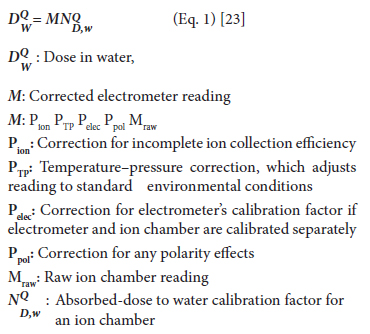
Equation for the dose absorbed in water for radiation of quality Q is
AQA test analysis for CyberKnife Robotic
Radiosurgery System
The AQA test is an isocentric targeting accuracy or
robot pointing test to verify delivery accuracy of CyberKnife
unit; it is similar to the Winston-Lutz test[24]
commonly used in gantry-based SRS/SRT systems. In
the present study, 242 AQA tests (from 2009-2013)
performed on CyberKnife system at Hacettepe University
were analyzed retrospectively. Custom designed
AQA phantom containing 2 cm tungsten ball hidden
in cubic phantom was used for the measurements (Figure

AQA Test Analysis for CyberKnife Robotic
Radiosurgery System
Between 2009-2011, 144 AQA tests performed on CyberKnife unit were found to be within the tolerance
limit of a radial error of <1 mm. Although 11 of the 98
measurements taken during 2012 and 2013 exceeded
the tolerance limit, 7 of 11 measurements were from
May 2012 and 4 were taken in November 2013. The
manipulator was recalibrated 2 times over 5 years. It
can be seen in Table
The study revealed that output of CyberKnife unit
was quite stable based on daily and annual measurements
(Figure
In addition to output stability, SRS/SRT facilities
with CyberKnife require high degree of targeting accuracy
or mechanical stability with respect to conventional
linac-based treatment techniques such as 3-dimensional
conformal radiotherapy (3DCRT), IMRT,
and VMAT. As small positioning errors in SRS/SRT
equipment can result in considerable changes to calculated
dose of target volume and affect adjacent critical
organs due to steep dose gradient and small target
volume. For this reason, effective QC program should
be implemented to ensure that the accuracy of the CyberKnife
system does not deviate significantly from
the baseline. AQA test is useful to check the spatial
coordinate system of the manipulator. In addition, detailed
analysis of AQA test results can provide valuable
information about the short-term and long-term mechanical
stability of the CyberKnife unit. In the present
study, mechanical stability of CyberKnife system
on yearly basis was analyzed and results indicated that
pointing accuracy of Cyberknife system was well below
the tolerance limit of 1 mm, as recommended by
AAPM TG-135, between the years of 2009 and 2011.
However, 11 of the 98 measurements taken in 2012 and
2013 exceeded tolerance value; 7 were taken in May
2012 and remaining 4 were taken in November 2013.
The manipulator, hence, was recalibrated only twice
over 5 years. Although, AQA test provide valuable information
about targeting accuracy, several parameters
should be controlled before each calibration and E2E
tests should be performed to ensure whether this deviation
is caused by the robot or other factors like film
scanner, film displacement and kilovoltage (kV) imaging
system.
Overall, analysis showed that output and mechanical
stability of CyberKnife was very reliable over 5 years.
Nevertheless, daily output measurements and AQA
test are strongly recommended by the AAPM TG-135.
AQA test is a quick test to evaluate the pointing accuracy
of CyberKnife unit. However it has several limitations
or disadvantages. The first is that it only provides
information on translational parameters (left-right,
superior-inferior and anterior-posterior) of the robotic
system. Second, it is very costly and time-consuming
to take daily measurements. Based on these limitations,
AQA tests should be modified by the manufacturer to
verify both translational and rotational parameters and
a new simple module designed for a quick check of
both mechanical and output stability of the system.
Acknowledgements
This study was supported by Hacettepe University Scientific
Research and Development Office Grant Project:
1-05 A 101 009.
Conflict of interest: None declared.