
METHODS
Data from 2010 to 2014 were obtained from Near East University (NEU) Hospital. Crude incidence rate
(CIR) and age-standardized rate (ASR) per 100,000 were calculated for 28 different cancers for males
and females. In line with GLOBOCAN 2012, ASR values for 2012 in NC were compared with South
Cyprus (SC) and Southern Europe (SE).
RESULTS
Total of 1,782 cancer cases were diagnosed. ASR value was 180.61 and 192.75 per 100,000 person-years for
males and females, respectively. Most prevalent male (M) cancers were lung, prostate, colorectal, thyroid,
and bladder. Similarly, for females (F), they were breast, thyroid, colorectal, lung, and non-melanoma skin
cancer. Thyroid cancer in females in NC was more prevalent than in SE. Breast (F), prostate, colorectal
(F), bladder (M), and ovary and corpus were less frequent than in SE and SC; cervix, larynx (M), brain
(M) and colorectal (M) only were less frequent than in SE, and the remainder were statistically similar.
CONCLUSION
Possible risk factors for the most common cancers in NC have been discussed; however, etiopathogenetic
scientific results are still needed. Risk factor studies should be performed to raise public awareness
and to plan future cancer prevention measures. The development of active cancer registry centers and
combining data under a single cancer organization is recommended.
Keywords: Adult; cancer incidence; comparison; North Cyprus.
As part of this study, we have reviewed the cancer
incidence information available for the period between
2010-2014. The study presents the findings of the NEU
Hospital Radiation Oncology and Medical Oncology
Departments. The NEU Hospital Oncology Departments
are the one of the main sources of cancer information
on the island and codes the sites, types and
morphological characteristics of cancer cases using the
International Classification of Diseases for Oncology.[
For the purposes of the present analyses, only the
registered cancer cases that were first diagnosed between
1st January 2010 and 31st December 2014 were
considered. Tourists and persons who had not been
resident in NC for more than six months prior to their
cancer diagnosis were not included in the registry. All
information received was treated as "confidential" and
was approved by the ethical committee of the university.
As NEU Hospital does not have a pediatric oncology
clinic, our research does therefore not include patients
under 15 years old. According to the census in 2011,
the North Cyprus population was 212,740, including
100,728 (47.35%) women and 112,012 (52.65%) men
in the 15 and over age group.[
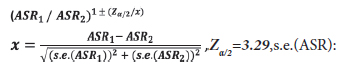
standard error of ASR.
If the interval does not include 1, the standardized
rates ASR1 and ASR2 are significantly different
(p<0.001).
The confidence intervals were calculated for male
and female patients"ages and the two-tailed t-test was
used with the aim of determining whether there was a statistically significant age difference between males
and females. The Chi-Square test was used to define
the differences between male and female patients in
relation to the percentages of cancer sites. Further confirmatory
analysis was performed using SPSS (version
20), (SPSS for Windows, Chicago, IL, USA).
From 2010 to 2014, the most common cancer sites
were female breast (340 cases, 19.4% of all cancer cases),
thyroid (212 cases, 11.9%), lung (210 cases, 11.8%),
colorectal (139 cases, 7.8%) and prostate (130 cases,
7.3%). Lung (169 cases, 20.1% of all cancer cases in
male patients), prostate (130 cases, 15.5%), colorectal
(91 cases, 10.8%), thyroid (52 cases, 6.2%), bladder (40
cases, 4.8%), non-Hodgkin lymphoma (38 cases, 4.5%)
and non-melanoma skin (33 cases, 3.9%) cancers were
the most prevalent cancers in male patients. For female
patients, the most prevalent cancers were breast (340
cases, 36.1% of all cancer cases in female patients),
thyroid (160 cases, 17.0%), colorectal (48 cases, 5.1%),
lung (41 cases, 4.3%), non-melanoma skin (37 cases,
3.9%), non-Hodgkin lymphoma (35 cases, 3.7%) and
brain-nervous system (34, 3.6%), respectively. During
this five year period, the standardized incidence rates
of lung, colorectal, kidney-renal pelvis ureter and bladder
cancers were significantly higher in men than in
women among the population aged 15 and over. Breast
and thyroid cancers were significantly higher for women
(p<0.001) (Table
When males were compared based on age range for
the most common types of cancer, lung and prostate
had the highest incidence rates in the 70 and over age
group. Colorectal and bladder cancers had the highest
incidence between the ages of 60 and 69. When females
were compared based on age range for the most
common sites of cancer, breast, colorectal, lung and
non-melanoma skin had the highest incidence rates
between the ages of 60 and 69 years. Most cancers
had the highest incidence rates among the age groups
60-69 and 70+. In the younger age group, testicular
cancer had the highest incidence rate. In females,
thyroid cancer and malignant brain tumors had the
highest incidence rates in the middle age group. For
both genders combined, lung and colorectal cancers
had the highest incidence between the ages of 60 and
69 years (Fig.
As can be seen in Table
The crude incidence rates for both male and female cancer patients excluding non-melanoma skin cancers for the years between 2010-2014 were 143.91 and 179.89 per 100,000 North Cyprus resident population in the 15 or over age group per year, respectively. The corresponding age-standardized incidence rates were 173.7 and 185.52 per 100,000 person-years.
Selected Cancers and Comparison with Globocan
2012 Data: Comparisons between NC and SE and between
NC and SC should be interpreted with caution
(Fig.
All cancers excluding non-melanoma skin cancers: The mean age of the patients was 60.4 (CI 95%: 59.7- 61.1). The mean age of male patients was 63.3 and the mean age of female patients was 58.8. The average age difference between men and women was statistically different (p<0.001). In total, 47.1% of the patients were male and 52.9% of them were female. The ASR in NC for adult women and men was significantly lower than in SC and SE.
Breast Cancer (C50): During the study period, only 12 adult men with breast cancer were recognized, therefore breast cancer was investigated only for women. The mean age of the patients was 58.7 years (CI 95%: 57.3-60.0). The ASR in adult women in NC was significantly lower than the ASR in SC and SE.
Thyroid Cancer (C73): The mean age of the thyroid cancer patients was 48.1 (CI 95%: 46.2-49.9). The mean age between the two genders was not different as the mean age for males was 48.5 and for females was 47.9 (p=0.7868). 24.5% of the patients with thyroid cancer were male and 75.5% of them were female. The ASR in adult women in NC was statistically the same as the ASR for SC's adult women (p=0.0031); however, it was significantly greater than the ASR in SE's adult women. For men, the ASR in NC was statistically the same as the ASR in both SC and SE's adult men (p=0.0668, p=0.1112).
Colorectal Cancer (C18-21):The mean age of the patients with colorectal cancer was 65.8 (CI 95%: 63.9- 67.7). The mean age between the two genders was not statistically different as the mean age for males was 65.5 and for females was 66.4 (p=0.6587). A total of 65.5% of the patients were male and 34.5% of them were female. For women, the ASR in NC was significantly lower than the ASR in SC and SE. However, for men, the ASR in NC was statistically lower than the ASR in SE but statistically the same as in SC (p=0.0188).
Lung Cancer (C34):The mean age of the patients with lung cancer was 65.1 (CI 95%: 63.6-66.6). The mean age between the two genders was statistically different. The mean age of the male patients was 66.7 and the mean age of the female patients was 58.7. A total of 80.5% of the patients were male and 19.5% of them were female. For women, the ASR in NC was statistically the same as in both SC and SE (p=0.8577, p=0.0465). In the same manner, for men, the ASR in NC was statistically the same as in both SC and SE (p=0.9878, p=0.002).
Non-melanoma skin (C44): The mean age of the patients with non-melanoma skin cancer was 67.1 (CI 95%: 64.2-70.0). The mean age between the two genders was not statistically different (p=0.3644). The mean age of the male patients was 68.5 and the mean age of the female patients was 65.8. A total of 52.9% of the patients were male and 47.1% of them were female.
Stomach (C16): The mean age of the patients with stomach cancer was 65.5 (CI 95%: 62.4-68.6). The mean age between the two genders was not statistically different (p=0.1428). The mean age of the male patients was 63.4 and the mean age of the female patients was 68.1. A total of 55.1% of the patients were male and 44.9% of them were female. For women and men in NC, the ASR was statistically the same as in SC (p=0.2266, p=0.0475) but significantly lower than in SE.
Non-Hodgkin Lymphoma (C82-85, C96): The mean age of the patients was 58.1 (CI 95%: 54.1-61.9). The mean age of the two genders was not statistically different (p=0.7370). The mean age of the male patients was 57.4 and the mean age of the female patients was 58.7. A total of 52.1% of the patients were male and 47.9% of them were female. For women in NC, SC and SE, the ASR values were statistically the same (p=0.0853, p=0.0778). In Addition, for men in NC, SC and SE, the ASR values were statistically the same (p=0.2327, p=0.0197).
Bladder (C67): 74.1% of the bladder cancer patients were male and the mean age of those male patients was 68.15 (CI 95%: 64.03-72.27). The ASR value in NC for adult men was significantly lower than in SC and SE.
Cervix uteri (C53): The mean age of the patients was 57.0 (CI 95%: 53.1-62.3). The ASR in NC for adult women was significantly lower than in SE. However, it was statistically the same as SC's ASR.
Corpus uteri (endometrium) (C54): The mean age of the patients was 69.6 (CI 95%: 66.1-73.0). The ASR value in NC for adult women was significantly lower than the ASR in SC and SE.
Ovarian (C56): The mean age of the patients who had ovarian cancer was 59.3 (CI 95%: 54.5-64.1). The ASR value in NC was significantly lower than the ASR in SC and SE.
Prostate (C61): The mean age of the prostate cancer patients was 69.9 (CI 95%: 68.1-71.3). The ASR value in NC for men was significantly lower than in SC and SE.
Brain (C71-72): The mean age of the patients who had brain cancer was 48.5 (CI 95%: 43.5-53.6). The mean age between the two genders was statistically different. The mean age of the male patients was 67.4 and the mean age for female patients was 44.4. A total of 52.3% of the patients were female and 47.7% of them were male. For men, the ASR in NC was statistically the same as in SC (p=0.0044) but was statistically lower than in SE. For women, the ASRs in NC, SC and SE were statistically the same (p=0.0387, p=0.0107).
Larynx (C32): From 2010 to 2014, no cases of larynx cancer was observed in females; however, 30 male patients were observed. The mean age of male patients was 65.4 (CI 95%: 62.7-68.2). In addition, the ASRs for female patients in SE and SC were lower with 0.98 and 0.58 (almost zero), respectively. For male patients, the ASRs in NC and SC were statistically the same (p=0.5120) and the ASR in NC was significantly lower than in SE.
According to a recent study concerning the incidence
of cancer in Turkey (2009), the most prevalent
cancers in women were breast, thyroid and colorectal
cancers. In men, lung, prostate and bladder cancers
were more common.[
2010-2014 head and neck, upper gastrointestinal,
hematological and gynaecological cancers were compared
separately, as seen in Table
The most frequent head and neck cancers (83 total
cases, 4.7% of all cancers cases) were firstly lip and
oral cavity (33 cases, 39.8% of head and neck cancers), secondly male larynx (30 cases, 36.1%) and lastly nasopharnyx
(11 cases, 13.3%). A similar ranking was obtained
for only males with larynx (30 cases, 46.2%), liporal
cavity (22 cases, 33.8%) and nasopharynx (7 cases,
10.8%) were observed. No cases of larynx cancer were
observed in female patients but lip-oral cavity cancers
(11 cases, 61.1%) were most commonly observed.
As colorectal cancers were evaluated separately, the
most frequent upper gastrointestinal cancers (129 total
cases, 7.2% of all cancer cases) were stomach (51
cases, 39.6% of upper GI cancers), pancreas (28 cases,
21.7%) and liver (27 cases, 20.9%). In male patients, the
rankings were found to be stomach (27 cases, 37.5%),
liver (17 cases, 23.6%) and pancreas (17 cases, 23.6%),
respectively. The same rankings were found for female
patients as were found in the overall statistics with
stomach (24 cases, 42.1%), pancreas (11 cases, 19.3%)
and liver (10 cases, 17.5%).
The most frequent hematological cancers (136 cases,
7.6%) in total were non-Hodgkin (73 cases, 53.7%
of hematological cancers), Hodgkin (28 cases, 20.6%)
and multiple myloma (26 cases, 19.1). The same ranking
was observed in females with non-Hodgkin (35
cases, 53.0%), Hodgkin (15 cases, 22.7%) and multiple
myeloma (11 cases, 16.7%). However, the male
patient ranking was non-Hodgkin (38 cases, 54.3%),
multiple myeloma (15 cases, 18.6%) and Hodgkin (13
cases, 18.6%).
In gynaecological cancers, corpus uteri (29 cases,
33.3%), ovarian (27 cases, 30.7%) and cervix cancers (24
cases, 27.2%) were observed most frequently. As seen
from these results, there were no statistically differences
between the incidences of gynaecological cancers.
According to the results obtained from case between
the years 2010-2014, the most common cancers
in males were lung, prostate, colorectal, thyroid and
bladder cancer. For females, the following cancers were
most frequently observed: breast, thyroid, colorectal,
lung and non-melanoma skin cancer. According to
the studies, both red meat/high-fat diets and smoking
were identified as factors that could increase the
risk of colorectal cancer.[
According to the results, the most common cancer
out of upper gastrointestinal cancers in males and
females is stomach cancer. Due to the consistently
good weather conditions, Turkish Cypriot people can
frequently be found grilling meat on the barbecue; it
is thought that frequent consumption of grilled meat
and the recurrent use of burnt oils may cause stomach
cancer. Previous studies have indicated that high consumption
of red meat (especially barbecue) increases
the risk of stomach cancer.[
In 2012, breast cancer was defined as the most
prevalent disease among women with an estimated
1.67 million new cancer cases worldwide; it represents
about 25% of all cancers.[
Lung cancer was the most frequently identified
cancer and a significant cause of global cancer deaths
among males, especially in less developed countries.
[
Furthermore, among head and neck cancers in
males, the most common type of cancer observed was
larynx cancer, while bladder cancer was also prevalent
in the male population. The major risk factor for bladder
and larynx cancer is smoking cigarettes.[
According to the results obtained for the years of
2010-2014, thyroid cancer ranked second in women
and fourth in men and therefore was one of the most
frequent types of cancer. The frequency varied according
to age and gender. It was observed infemales
(75.5%) more than in males (24.5%). Thyroid cancer
mostly occurred among people aged 45-54 and is seen
most commonly in women.[
Among the most common gynecologic cancers,
endometrium (corpus uteri) cancer also contains similar
etiologic factors as breast cancer. The reason why
endometrial cancer has increased in females is due to
an increase in being overweight, suffering from obesity
and a general lack of physical activity.[
Non-melanoma skin cancer was observed in females
in fifth place and in males, it ranked in seventh
place. Studies have indicated increased sun-exposure is
a high risk factor for non-melanoma skin cancers. It
is believed that because our island experiences almost
12 months of sun exposure, the risk of skin cancer is
frequently observed.
According to the statistics stated in both Northern
and Southern Cyprus, there is no significant statistical
difference between both the ASR values in females with
thyroid, lung, stomach, NHL, brain, cervix, and larynx
cancers and in males with thyroid, lung, colorectal,
stomach, NHL, larynx, and brain cancers. Based on
these results, we can specify that Northern and Southern
Cyprus both have similar environmental factors
and culture of life. In 2009, according to the Turkish
Cancer Statistics, the most common female cancers were breast, thyroid and colorectal cancers; the most
frequent male cancers were lung, prostate and bladder
cancers.[
Overall, the mean age of female patients was significantly
lower than the mean age of men. An explanation
for this is that the cancer most experienced by males
was prostate cancer in older ages (average age: 70). Furthermore,
females most commonly experienced thyroid
cancer in middle ages (average age: 48). This result
is also consistent with the global statistics that show
that prostate cancer is the most common malignancy
among elderly men and thyroid cancer is most frequently
diagnosed among people aged 45-54.[
As one can see, most common cancer risk factors
are due to the consumption of cigarettes, poor eating
habits and the lack of physical activity.[
We have discussed the possible risk factors of the
most common cancers in NC, however, there is a need
for etiopathogenetic scientific results. This means that
risk factor studies can be carried out to inform the public
and to contribute significantly to future preventative
measures. Additionally, the development of cancer registry
centers,switching to an active cancer registry system
and combining the data obtained from all health care
providers under a single cancer organisation are recommendedin
order to obtain more comprehensive data.
Acknowledgments
Disclosure Statement
This research is the project of NEU Hospital. We hereby
thank all the doctors and staff of the Radiation Oncology
Department, Nuclear Medicine Department and
all other departments in the hospital for their assistance
and support during the investigation, including primarily
the radiation oncology department. Also, we would like to individually thank Prof. Dr. Suna Kıraç, Asst.
Assoc. Dr. Deniz Bedel in Nuclear Medicine, Assoc. Dr.
Orgun Deren in Plastic Reconstructive and Aesthetics
Surgery, Dr. Didem Mullaaziz in Dermatology and
Prof. Dr. Ali Ulvi Önder in the Urology Department.
We also wish to thank Mr. Simon Thompson for language
editing and proofreading of the manuscript.
The authors declare no conflicts of interest.