

METHODS
Fifty patients diagnosed with low-risk prostate cancer who were treated between 2009 and 2021 were
identified retrospectively. Conventional (CF) and ultra-hypofractionated (HF) volume-adjusted arc plans
were calculated for selected prostate patients. Mathematical formulations were created for radiobiological
modeling of tumor control probability (TCP) and normal tissue complication probability (NTCP) in the
Matlab program. Dose-volume histogram (DVH) data of the plans were examined in the Matlab program.
RESULTS
Bladder and rectum NTCP values were significantly lower in the HF technique compared to the CF technique
(p<0.05). For femoral heads, NTCP was similar (p=0.317). For the planned target volume, TCP
values obtained with the HF technique are significantly higher compared to the CF technique (p=0.000).
CONCLUSION
Higher TCP values were obtained with the HF technique. It has been observed that normal tissues receive
lower doses. This may be associated with high local control rates while providing similar toxicity.
HF treatment may be preferred in prostate cancer because the total treatment duration is shorter and
the dose applied to critical organs is lower. Radiobiological models are very instructive for comparing
treatment schemes in radiotherapy plans. The Matlab program we created is a very helpful tool for the
radiation oncologist and medical physicist to evaluate their plans.
Keywords: Conventional and hypofractionated radiotherapy; EUD; matlab; NTCP; radiobiological modeling; TCP
Fractionation types vary according to the reduction
of normal tissue toxicity while giving the necessary dose
to control the cancer cell. As a result of clinical experience,
the type of fractionation in which tumor control is
achieved without losing the function of normal tissues?
a daily tumor dose of 1.8?2 Gy is applied five times a
week?is called conventional fractionation. As the fraction
dose applied to the tumor exceeds 2 Gy, the tumor
damage rate increases. Radiotherapy is one of the frequently
preferred treatment methods in the treatment
of prostate cancer. Numerous studies have been carried
out around the world for more effective radiation doses
in the last 20 years, which have seen the radiation doses
for these diseases being changed, especially in recent
years. It has been shown that switching to a hypofractionated
dose in prostate cancer increases the efficacy of
treatment on the tumor, reducing the side effects, hence
leading to cost-effective treatment.[
Success in clinical radiotherapy is related to radiation
dose. Low doses have little ability to destroy the
tumor. Local disease control can be achieved at high
doses. There is a sigmoidal relationship between the
probability of tumor control and the dose. For any
type of cancer, this curve is associated with treatment
success. The dose-response curve depends on some
biological factors such as the time elapsed after radiotherapy,
the duration of the radiation dose, the volume
of irradiated normal tissue, and the quality of the beam
used for radiotherapy in relation to the response of
the tissues to radiation.[
Preventing various complications can be achieved
by limiting the dose to which normal tissues will be
exposed. The dose that can control half of the tumor
volume is called TCD50, and the TCD50 value and the
slope of the dose-response curve are important.[
Conventional dose-volume histograms do not compare
different fractionation schemes, hence making it difficult to compare plans with conventional DVH.[
The linear quadratic model (LQ) model is commonly
used in fractionated external radiotherapy to
describe the dose response to the survival of cells in
the irradiated volume. TCP/NTCP curves can be used
to compare and select the best plan for treatment.[
Clinicians have to rely on the DVH characteristics
of different tissues when evaluating a plan. The TCP/
NTCP radiobiological model uses clinical data based
on the dose-volume characteristics of different tissues.
Radiobiological modeling plays an important role in
the creation of the treatment plan and in the optimization
process. The radiobiological model of TCP is a
measure of success in treatment.[
TCP and NTCP models need tissue-specific parameters
and NTCP curves have 95% reliability. Commonly
used NTCP models are the Lyman et al.[
Biological optimization is a treatment plan that
takes into account radiation-related biological parameters,
including the possibility of tumor control and the
possibility of complications that may occur in normal
tissue.[
Matlab programming language is used in many areas
of engineering and science. A matrix-based calculation
language is used. It has a user-friendly interface
and is practical to use. It is a program that can also be
integrated into other programming languages.[
This study aims to investigate the most appropriate
treatment technique for clinical use by examining
the effects of conventional and ultra-hypofractionated
treatment schemes on normal tissue complications
and the possibility of tumor control using the
equivalent uniform dose (EUD)-based radiobiological
model created in Matlab.
Treatment plans were performed using 2 arc treatment
fields with 6 MV x-ray energy in the Eclipse V13.6
(Varian Medical Systems, Palo Alto, CA) treatment
planning system. The first full arc angle was determined
as 181?179 degrees in the clockwise direction, and the
second full arc was determined as 179-181 degrees in
the counterclockwise direction. A 30-degree collimator
angle was used to minimize leaf leakage between
two arcs. In Figure
HF and CF plan DVH is shown in Figure 2. With
HF planning, less bladder and rectum doses, as well as
more PTV doses, appear to be on DVH. The femoral
heads appear to receive more doses in the low-dose region
with the HF treatment technique.
For prostate cancer patients, a total of 5 fractions
of 6.7 Gy/fraction/every other day for HF and a total
of 39 fractions of 2 Gy/fraction/day were used as the
conventional scheme.[
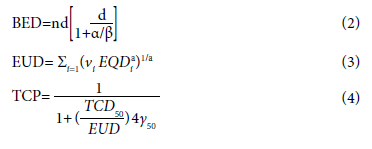
Di fraction dose, n is the number of fractions.
a and γ are the unitless model parameters for normal
and target volume. vi is the volume that receives
the Di dose in its partial volume. nf is the number of
fractions. α/β is a tissue-specific parameter according
to the linear quadratic model. In radiotherapy, TCP
≥0.5 and NTCP ≤0.05 are generally preferred.[
EUD gives information about equivalent doses
that produce the same biological effect between two
dose distributions. 2 Gy radiation dose is a parameter
that represents the clonogen number and sensitivity
to radiation.[
Gay and Niemerko calculated the NTCPGN according
to the mean lung dose.[
In Equation 3, Equation 4, and Equation 5, Vi is
the volume of the organ that receives the Di dose, and
a=1/n is the tissue-specific partial volume parameter.
TD50 is the dose that causes 50% damage when the relevant
organ is irradiated homogeneously.
There are programs in the literature for TCP and
NTCP calculations.[
In our study, we used Equations 1, 2, 3, 4, and 5
for TCP and NTCP evaluation. Cumulative DVH data
were calculated for PTV, bladder, rectum, and femoral
heads in HF and CF prostate cancer plans.[
The Statistical Package for the Social Sciences
(SPSS) V25 program was used for statistical analysis.
Whether the data showed normal distribution was examined
with the Kolmogorov-Smirnov test. Paired ttest
was applied to normally distributed data sets, and
Wilcoxon matched-pair signed-rank test was applied
to data sets that did not show normal distribution. Values
below p<0.05 were considered significant based on
the alpha error rate of 5%.
HF: Hypofractional dose; CF: Conventional.
CF: Conventional; HF: Hypofractional dose; DVH: Dose-volume histogram; EQD2: Gy equivalent dose; PTV: Planning target volumes; Gy: Gray.

The radiobiological effects of hypofractional and
conventional treatment techniques on low-risk prostate
cancers were shown in Table
As shown in Table
It was discovered that the bladder EUD and NTCP values were significantly lower in hypofractional treatment. The NTCP value was computed lower in the hypofractionated treatment technique, despite the fact that the rectum EUD values were similar in both treatment approaches.
Nuraini et al.[
Mesbahi et al.[
The HF technique demonstrated significantly higher
TCP values compared to the CF technique, indicating
a greater likelihood of tumor control with the HF
regimen. This is attributed to the higher doses administered
to the tumor over fewer fractions, which intensifies
the radiation effect while reducing overall treatment
time. These findings align with the results of other
studies, such as those conducted by Clemente-Gutiérrez
et al.[
Our results show that the NTCP values for bladder
and rectum were significantly lower in the HF plans
compared to CF plans, suggesting that HF is less likely
to cause complications in these tissues. This is consistent
with Mesbahi et al.[
The HF technique's higher TCP and lower NTCP
values for critical organs indicate that this method may
offer superior clinical outcomes compared to CF. HF
treatment, with its shorter overall duration, is more
convenient for patients and may result in fewer side effects.
This aspect of patient comfort and reduced treatment
burden is crucial in clinical settings.
Clemente-Gutiérrez et al.[
The use of radiobiological models proves invaluable
in comparing different treatment schemes and
should be a standard component of radiotherapy
planning systems.[
While our study provides compelling evidence supporting the use of HF in low-risk prostate cancer, it is essential to consider the limitations associated with radiobiological modeling. Factors such as individual patient characteristics, tissue-specific responses, and other treatment variables like chemotherapy and surgery must be accounted for in future studies. Integrating comprehensive radiobiological models into clinical practice will enhance treatment planning and outcomes.
High fraction doses are especially suggestive for normal tissue complications compared to standard fraction doses. Since many factors, such as NTCP modeling, patient characteristics, cell structure, chemotherapy, and surgery, affect toxicity, studies should be conducted to include all parameters. Radiobiological models are needed for safer and more curative treatments at high doses. Since it is difficult to compare different plans with normal DVH, radiobiological model parameters should be integrated into today's planning systems in order to determine the damage to the tissue, and treatment plans should be created with these parameters.
The study's findings underscore the potential benefits of HF radiotherapy in achieving higher tumor control with fewer complications compared to conventional fractionation. These insights are pivotal for optimizing prostate cancer treatment protocols and improving patient quality of life.
Ethics Committee Approval: The study was approved by the Kocaeli University Non-Interventional Clinical Research Ethics Committee (no: 2021/265, date: 16/12/2021).
Authorship contributions: Concept - A.Ü.K., M.S.K., M.G.A., Ö.G.; Design - A.Ü.K., B.T., G.Ö., A.O.K.; Supervision - A.Ü.K.; Funding - M.G.A., Ö.G.; Materials - A.Ü.K., B.T., G.Ö., A.O.K., U.D.; Data collection and/or processing - A.Ü.K.; Data analysis and/or interpretation - A.Ü.K., U.D., M.S.K., M.G.A., Ö.G.; Literature search - A.Ü.K., B.T., G.Ö., A.O.K.; Writing - A.Ü.K.; Critical review - A.Ü.K., U.D., M.S.K., M.G.A., Ö.G.
Conflict of Interest: All authors declared no conflict of interest. Use of AI for Writing Assistance: Not declared.
Financial Support: None declared.
Peer-review: Externally peer-reviewed.